Amiga 500
Early vs Late A500
At first glance every Amiga 500 model sold since 1988 through to 1992 may look the same. But there are some subtle difference to be aware of. For avid collectors of Amiga these differences matter, and a collection with all the key models is highly desirable.
Throughout the lifecycle Commodore made a number of changes and revisions for example case designs, main board revisions, keyboards, power and drive light colours, not to mention custom chip manufacturers and various suppliers used for passive components
Cases
Looking at case designs there's 3 key difference which can be seen below. The very early C= logo is moulded into the case. This didn't seem to last long, and Commodore soon changed to an inserted logo. Right near the end of its lifecycle, likely as they were preparing to introduce the A500 plus and found they had excess parts for the standard A500 released some with what was very likely the A500 plus case but with a different insert.
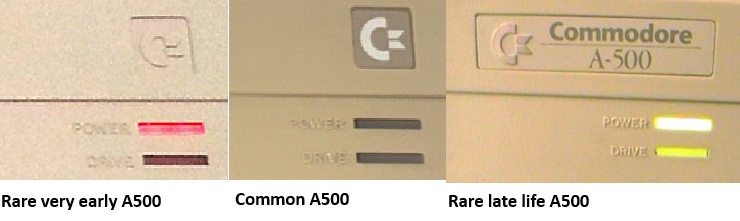
Next we have the power and drive lights. As can be seen above the early models had a red power and green drive light while later models had green power and amber floppy. As the LEDs are part of the keyboard we need to take into account the keyboard differences.
Keyboards
I won't discuss the different layouts except to say Commodore sold country appropriate keyboard layouts.
There are 3 models of keyboards Commodore used:
- Hi-Tek mechanical. Very early A500 only. These use individual switches for each key. They are identified by the "Commodore' keycap used on the left Amiga key. They use PBT plastic so don't yellow. This is the most sought-after keyboard
- Samsung membrane. Not that common. They use ABS plastic for the keycaps so yellow over time. Look the same as the Mitsumi however how the keycaps attach to the keyboard differs. These ones also have two connectors for the membrane.
- Mitsumi membrane. This seems to be 90% plus of all A500s made. . They use ABS plastic for the keycaps so yellow over time. These have one connector for the membrane and it's easy to get replacement membranes

Main boards
There were 4 major variants of the A500 main PCB and a number of sub variants. Over its lifetime Commodore made improvements, reduced costs and fixed up mistakes. The bigbookofamigahardware.com provides a great rundown of the differences. I'll explain them briefly here.
- Rev3, the very first production version. This is quite rare and likely was superseded quite quickly. It came with Kickstart 1.2 and had a number of bugs
- Rev5, quite a common version. This revision has 3 sub types and got sold with both Kickstart 1.2 and 1.3. It came with an 8371 Agnus chip that only supported 512k of chip ram
- Rev6A, a very common version. It came with a newer 8372 version of the Agnus that could support 1Mb of chip RAM. This revision has kickstart 1.3
- Rev8, this is quite rare as it's the same board used in the A500plus. This would have appeared in very late model A500 where Commodore were not yet ready to start selling the A500plus. It had no battery in it, no real time clock components and only 512k of RAM chips soldered onto the board
I have never got my hands on a Rev3 or on a Rev8 setup for an A500 rather than 500plus. My early model 'chicken lips' machine came with a Rev5 type 2 and I'm certain it hasn't been replaced as it has a date code of 1987. I also have a late model A500 with the rectangle logo which came with the Rev6A board.
As the 500plus model came with a Rev8 board, but with the battery soldered on this almost always means board damage from a leaking battery. So getting your hands on a Rev8 board that was in a non A500plus means you get yourself an undamaged original and rare Rev8.
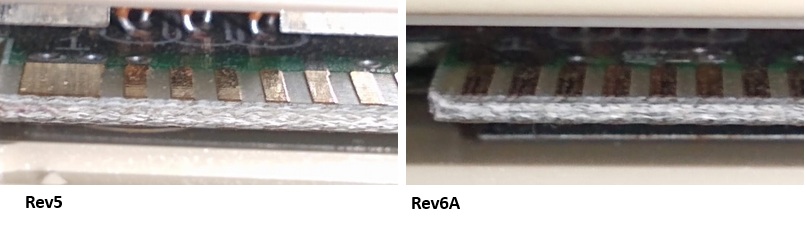
Without opening the case there's only one way to tell the boards apart. If you look at the edge connector and you see one end with a wide gold pad/contact then you know its either a Rev3 or Rev5. If they are thin contacts then it's either a Rev6A or Rev8. If you look really closely you can tell the Rev3 from the Rev5 or the Rev6A from the Rev8 but chances are you're looking at an online auction and won't have that resolution of picture.
Further reading can be found here and here
Serial numbers
There is no consensus on serial numbers and how to identify a true early lifecycle A500 just by looking at the serial number. First up Amigas were made all over the world. Hong Kong is where most New Zealand Amigas seem to have been made. The very early release Amiga would have likely started in Germany. I have a an early 'chicken lips' A500 made in Hong Kong with serial number 000904 which while having the keyboard, red power light but the regular C= logo and a Rev5 motherboard with 1.2 ROM. Commodore were anything but consistent!